Cycling in the Netherlands in 2035
31 DEC 2025
BY JOS SLUIJSMANS
4 MINUTE READ
ORIGINALLY PUBLISHED IN ‘DROMEN OVER 2035‘, BY FIETSERSBOND
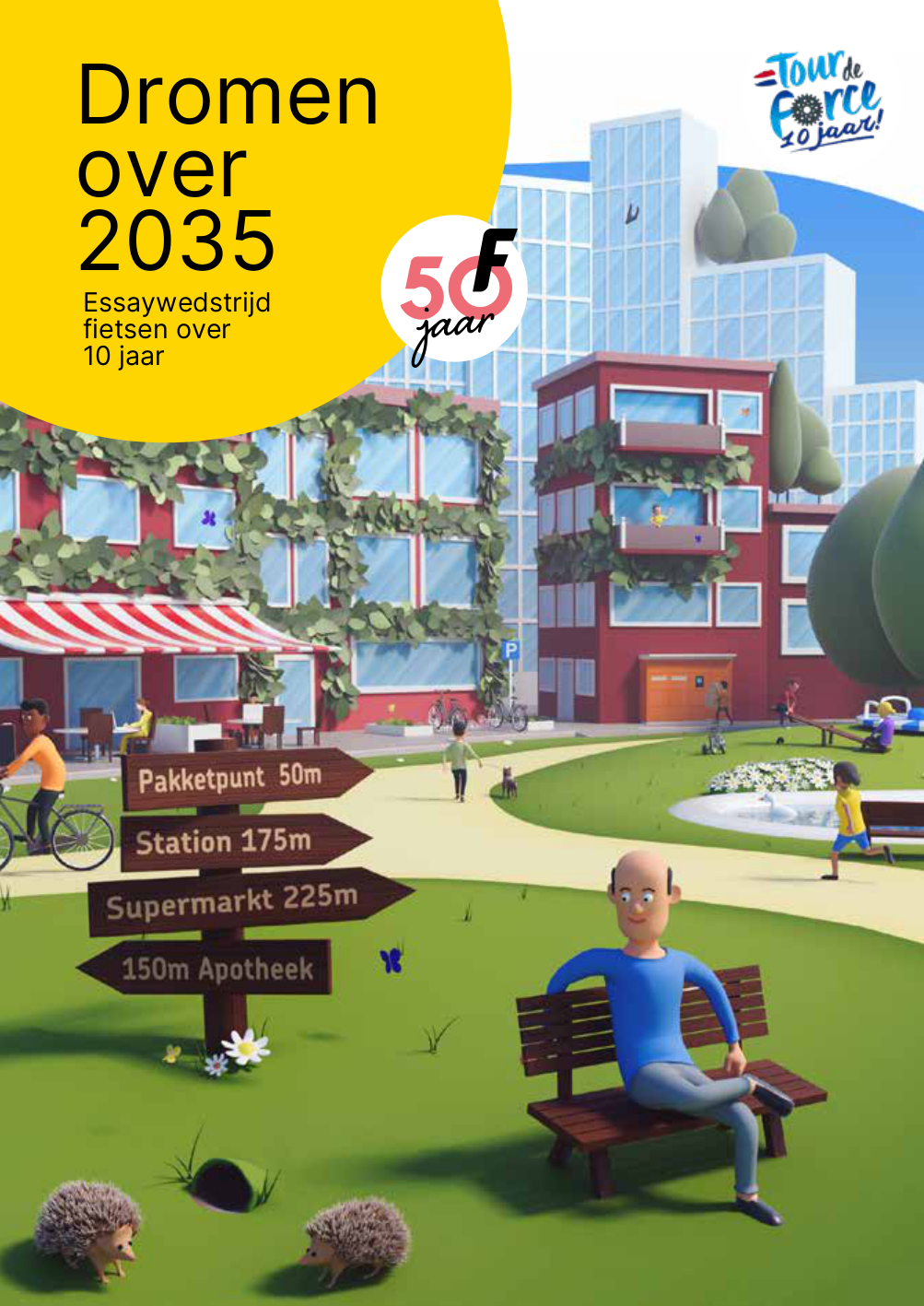
This article is included in the essay collection Dromen over 2035 (Dreams about 2035) in honour of 10 years of the Tour de Force project and 50 years of Fietsersbond, the Dutch Cyclists’ Union.


By 2035, the Netherlands will be organised in such a way that it will enable the most vulnerable residents of cities, towns and villages – children, the elderly, people with disabilities – to live and move around independently and safely. A city, town or village in which both an eight-year-old child and an octogenarian can move safely and independently from A to B is one in which everyone can move around safely and independently. By “safe”, we mean in terms of both traffic and social safety. Bicycles and bicycle-like vehicles are essential to achieving this goal.
In 2025, the Dutch municipality of Renkum was the first municipality in the Netherlands to explicitly prioritise the principle that every child has the right to travel to school independently from the age of eight. In doing so, the municipality of Renkum is acting in accordance with the International Convention on the Rights of the Child (adopted by the UN General Assembly on 20 November 1989), which aims to guarantee the rights and welfare of all children. This concerns in particular Articles:
- 6: Right to life, survival and development;
- 24: Right to health care and safety;
- 27: Right to an adequate standard of living; and
- 28 and 31: Right to education and play.
Applied to traffic, this means that children in Renkum from the age of eight can independently reach their school, shops, sports and cultural venues, etc., either on foot or by bicycle. Children have the right to be able to go to school or playgrounds safely and to be in safe environments, such as traffic-free, safe play areas and school environments. By 2035, many municipalities in the Netherlands will have followed the good example set by Renkum.
By 2035, our towns and villages will be accessible to people with disabilities in accordance with the Triple A principle: Accessibility for all Ages and Abilities, accessibility for people of all ages, with or without disabilities. Municipalities will comply with the UN Convention on the Rights of Persons with Disabilities, in particular Articles 20 (accessibility) and 21 (freedom of expression and information).
For people who, for whatever reason, are unable or unwilling to travel independently, there are various sustainable transport services available, such as tandem taxis, bicycle taxis, duo bikes and other multi-person bikes. There are also dozens of shuttle services with solar trains in the cities. Drivers and “pilots” of these vehicles receive a basic income and together they can operate a comprehensive transport system for all city residents and visitors who are unable to travel independently.
By 2035, there will be no more room in cities for personal and individual transport in fossil fuel-powered vehicles weighing 1,500 to 2,000 kilograms. Mobility in the city is primarily active mobility: walking and cycling, with or without electric assistance. Vehicles will seat one or two people and generally weigh no more than 200 or 300 kilograms. The maximum speed in cities will be 30 kilometres per hour across the board. At that maximum speed, accidents will be virtually non-existent, and if a collision does occur, it will almost never be fatal and will result in relatively minor injuries.
I would like to emphasise here that 30 kilometres per hour is the maximum speed in the city and not the standard speed. This means that you are allowed to drive at 30 kilometres per hour when conditions are optimal. In busy traffic, fog, slippery conditions, low sun or other less than ideal conditions, you must adjust your speed to the conditions at that moment.
In areas with many pedestrians, the maximum speed is 15 kilometres per hour. Motorised vehicles are equipped with ISA, Intelligent Speed Assistance. The system knows exactly where speed limits apply and prevents vehicles from driving faster than is permitted in that location. It’s all about convenience!
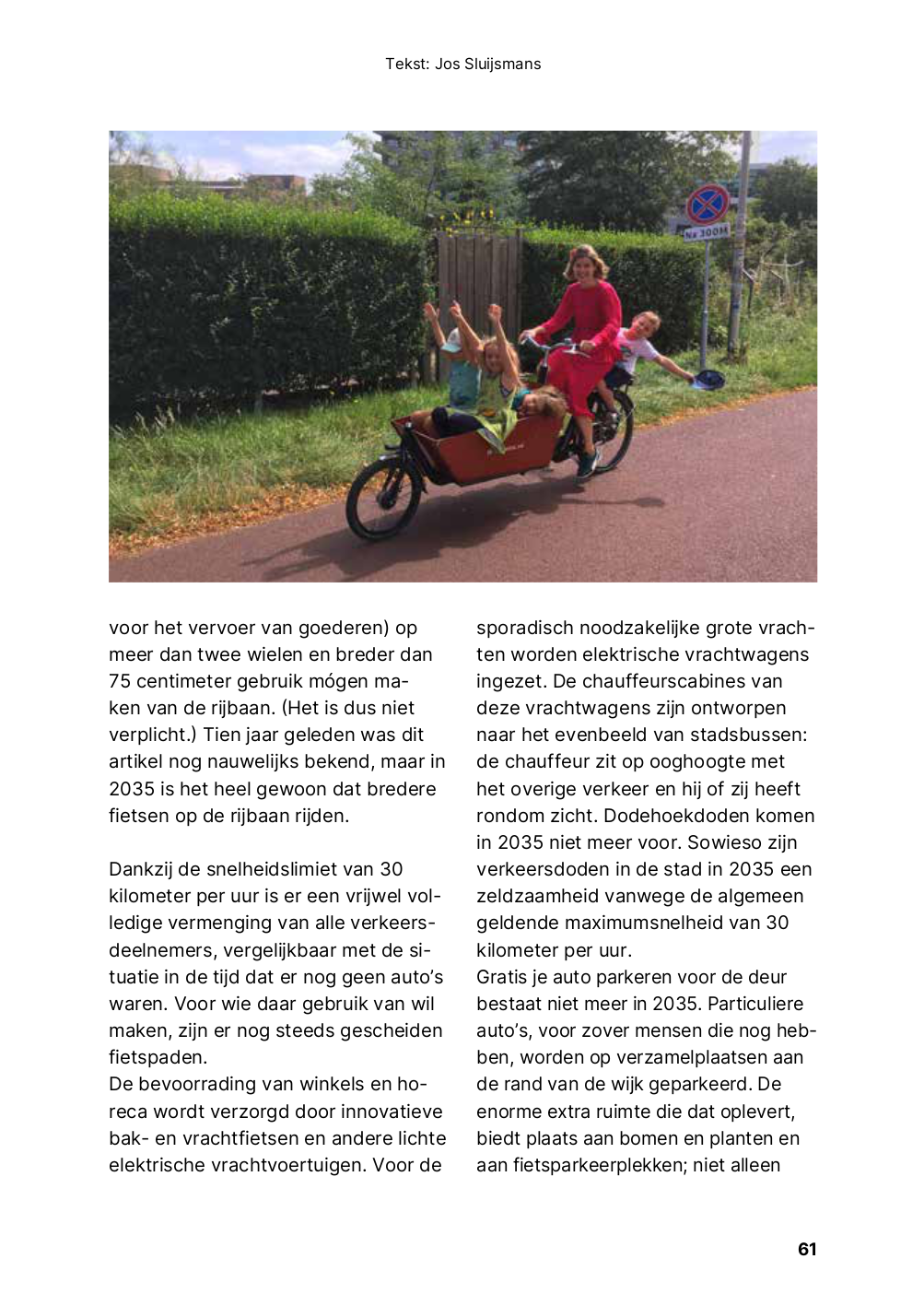
According to Article 5, paragraph 4 of the 1990 Traffic Regulations and Traffic Signs Regulations (RVV 1990), riders of bicycles with more than two wheels that are wider than 0.75 metres, including their load, and bicycles with trailers that are wider than 0.75 metres, including their load, are permitted to use the road. This means that transport bicycles, cargo bicycles, velomobiles, tandems, duo bicycles, rickshaws, and bicycles with trailers (e.g. for transporting goods) with more than two wheels and wider than 75 centimetres may use the road. (In other words, it is not mandatory.) Ten years ago, this article was hardly known, but in 2035 it will be quite normal for wider bicycles to ride on the road.
Thanks to the speed limit of 30 kilometres per hour, there is practically complete mixing of all road users, comparable to the situation in the days before cars existed. For those who wish to use them, there are still separate cycle paths.
Shops and restaurants are supplied by innovative delivery and cargo bikes and other light electric freight vehicles. Electric lorries are used for the occasional large loads. The cabs of these lorries are designed to resemble city buses: the driver sits at eye level with other traffic and has a panoramic view. Blind spot deaths will no longer occur in 2035. In any case, traffic fatalities in the city will be rare in 2035 due to the generally applicable speed limit of 30 kilometres per hour.
Free parking in front of your doorstep will no longer exist in 2035. Private cars, insofar as people still have them, will be parked at collection points on the outskirts of neighbourhoods. The enormous extra space this creates will accommodate trees and plants as well as bicycle parking spaces, not only for regular bicycles, but also for tricycles, cargo bikes, duo bikes and other bicycle-like vehicles.
In many Dutch cities, bicycle parking spaces for adapted bicycles will have been created next to the entrances of businesses, organisations and institutions by 2035. This promotes the independence and autonomy of people who depend on an adapted bicycle or a handbike for transport.
There are benches and other seating areas everywhere. Children can play in the streets, just like in the 1950s, 1960s and 1970s. The street is once again a meeting place for young and old.
In 2035, following the example of the Colombian capital Bogotá, many Dutch cities will have a so-called Ciclovía, a “cycle path” for recreation, where you can walk, jog, run, skate, cycle, dance, organise sprints, whatever you want. To this end, every Sunday morning, a number of thoroughfares with a combined length of at least 10 kilometres will be closed to motorised traffic from 7 a.m. to 2 p.m. For other necessary motorised traffic, there are plenty of other roads available on Sunday mornings.
The Ciclovía connects different neighbourhoods of the cities and makes it easier for residents to interact with each other. Anyone who wants to can travel the entire route or part of it in complete freedom, unhindered by motorised traffic.
By 2035, the cities will be connected by a network of cycle routes and long-distance routes. These are high-quality two-way cycle paths that connect cities with branches to smaller towns, business parks and sports facilities. Every five kilometres along these routes, there will be rest and shelter areas with basic facilities for bicycle repairs, charging or changing batteries, water and litter bins. Mobile bicycle route stewards will be on call along the routes to help with breakdowns or other issues. They will also ensure that the routes remain clean and safe by carrying out minor maintenance and clearing up litter.
Everyone travelling freely and safely from A to B, with people rather than cars taking centre stage: that is what cycling in the Netherlands will look like in 2035.
Nijmegen, 30 August 2025, Jos Sluijsmans
This article is included in the essay collection Dromen over 2035 (Dreams about 2035) in honour of 10 years of the Tour de Force project and 50 years of the Fietsersbond. The entire essay collection with 12 articles is available to read in Dutch: download it here.